
Introduction
There are stories in country music that feel almost inevitable—tales of dusty roads, broken hearts, and small-town dreams stretching toward neon lights. And then there are stories like that of Ronnie Dunn, which don’t follow the expected script at all. His journey didn’t begin in a bar, a honky-tonk, or even a garage band rehearsal. It began in a place far quieter, far more structured—a seminary, where discipline, devotion, and spiritual calling shaped the rhythm of everyday life.
Before he became one half of Brooks & Dunn, before the stadium tours and chart-topping hits, Ronnie Dunn was a young man deeply engaged in theological study. He attended Abilene Christian University and later pursued graduate-level religious studies. For a time, it appeared his life would be devoted to ministry. His voice—rich, commanding, unmistakably soulful—seemed destined for sermons rather than stages.
But music has a way of revealing truths that doctrine sometimes cannot contain.
While studying in seminary, Ronnie Dunn began performing music outside of academic and religious settings. These weren’t grand performances at first—just appearances in bars and small venues, places where people gathered not for sermons, but for stories told through melody and steel guitar. It was here that his voice found a different kind of congregation.
And that’s where the conflict began.
Accounts from that period suggest that Ronnie Dunn faced disciplinary pressure from his religious environment for performing in bars. In many conservative settings, such venues were seen as incompatible with the expectations placed upon someone preparing for ministry. His actions were not necessarily rebellious in spirit—but they challenged the boundaries that had been set for him.
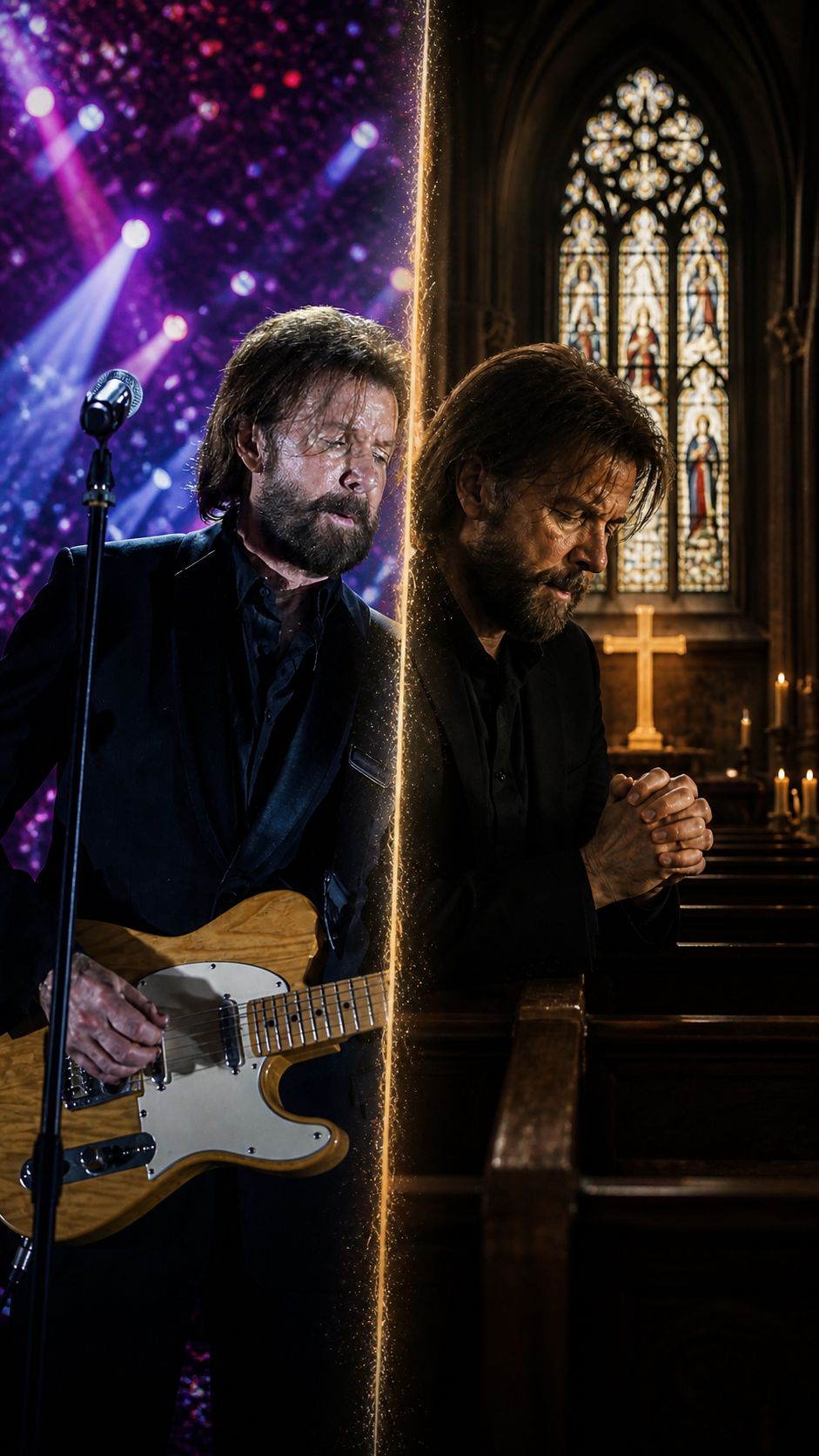
He was, in essence, living two lives.
By day, a student of scripture.
By night, a singer learning how to hold a room silent with a single line.
The tension between those worlds could not last forever.
At some point—there is no single dramatic moment recorded, no cinematic confrontation—Ronnie Dunn made a decision. Whether it was a quiet realization or a necessary response to institutional pressure, he stepped away from the path of formal ministry. That choice would become the hinge on which his entire life turned.
And country music would never be the same.
What makes this story so compelling isn’t just the contrast between seminary and stage. It’s how clearly you can still hear that early formation in his music. Listen closely to songs like Neon Moon or Believe, and you’ll notice something deeper than performance. There’s a gravity in his voice, a sense of reflection and moral weight that doesn’t come from nowhere. It comes from study, from contemplation, from wrestling with questions bigger than any chorus.
That’s the part casual listeners often miss.
Ronnie Dunn didn’t abandon faith—he reframed it.
Instead of preaching from a pulpit, he began expressing human struggle, redemption, loneliness, and hope through song. In many ways, his audience only grew larger, and his messages became more accessible. A barroom, after all, is not so different from a congregation—both are filled with people searching for meaning, comfort, and connection.
When he eventually partnered with Kix Brooks to form Brooks & Dunn, that emotional depth became one of the duo’s defining traits. While Brooks brought energy and stage charisma, Ronnie Dunn carried a voice that felt anchored in something older, something tested.
Their success was massive—dozens of hits, countless awards, and a permanent place in country music history. But beneath that success lies this quieter origin story, one that speaks not of fame, but of choice.
A choice between expectation and authenticity.
A choice between structure and expression.
A choice that many people face, but few navigate with such lasting impact.
And perhaps that’s why his voice still resonates today.
Because when Ronnie Dunn sings, it doesn’t sound like someone who simply learned music.
It sounds like someone who had to choose it—at a cost.
A Turning Point That Defined a Legacy
The idea that Ronnie Dunn was “warned” or “reprimanded” for singing in bars is not widely documented in official institutional records, but it persists in biographical narratives and interviews as part of his early-life tension between faith and artistic calling. Whether formal or informal, that pressure clearly influenced his decision to move away from seminary life.
And that decision, in hindsight, reads less like rebellion and more like alignment.
Because the truth is, Ronnie Dunn didn’t lose his voice when he left the seminary.
He found it.
Why This Story Still Matters
For listeners—especially those who have lived long enough to face difficult crossroads—this chapter of Ronnie Dunn’s life carries a quiet power. It reminds us that identity is rarely fixed, and that purpose sometimes emerges only after we step outside the roles others expect us to play.
Country music, at its best, tells the truth.
And in the case of Brooks & Dunn, that truth began long before the spotlight—
in a moment when a young man stood between two worlds,
and chose the one where his voice could finally be heard.


