
The Welsh political landscape has experienced a seismic “earthquake” following the official results of the 2026 Senedd (Welsh Parliament) election. For the first time in over a century of absolute dominance, the Labour Party has suffered a devastating defeat, marking the end of its single-party era in this traditional stronghold.
Immediately following the confirmation of the defeat, Welsh Labour Leader Eluned Morgan announced her resignation as First Minister, having also lost her own seat representing the Ceredigion Penfro constituency.

1. The New Distribution of Power
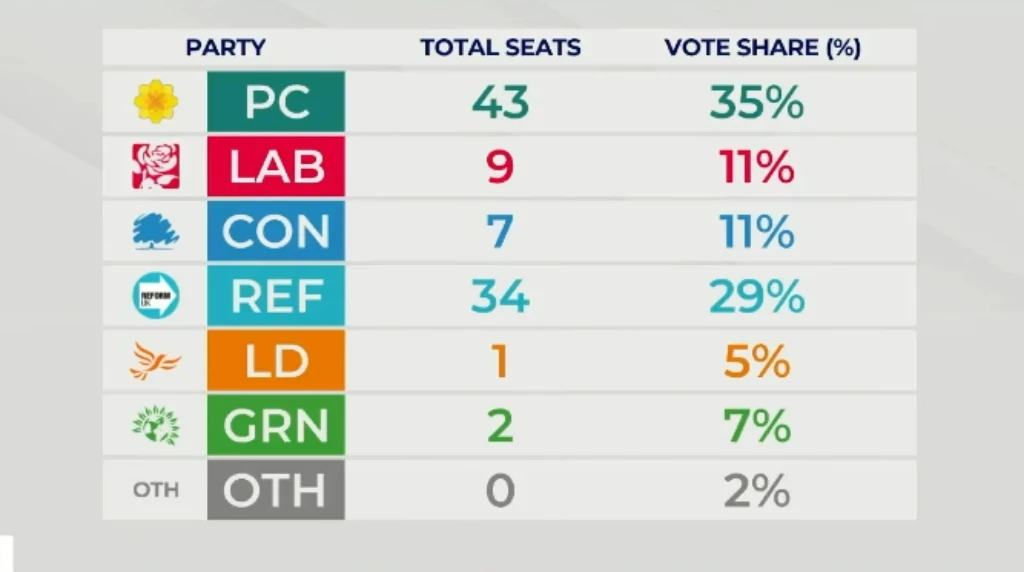
Following the expansion of the Senedd to 96 seats, the power structure in Wales has become deeply fragmented with the surge of new political forces:
-
Plaid Cymru (Party of Wales): The night’s biggest winner, securing 43 seats (35% of the vote).
-
Reform UK: Delivered a historic shock by coming in second with 34 seats (29% of the vote).
-
Welsh Labour: Experienced a total collapse, retaining only 9 seats (down from 30 in the previous smaller parliament).
-
Welsh Conservatives: Secured 7 seats (11% of the vote).
-
Green Party & Liberal Democrats: Shared the remaining seats with a modest 2 and 1 seat, respectively.
The political map of Wales is now sharply divided: the rural West and Northwest have turned Plaid Cymru green, while the industrial heartlands of the East and South witnessed a deep breakthrough by Reform UK.
2. “Heed the Anger, Do Not Feed the Anger”
In her resignation speech, Eluned Morgan described the results as “catastrophic” but emphasized that Labour must “look deep within itself” to face the scale of the challenge.
While acknowledging the voters’ thirst for change, Morgan warned that while politicians must “heed” public anger, they must not “feed” it—a comment widely interpreted as a direct swipe at Reform UK’s populist strategy. Echoing this sentiment, former First Minister Carwyn Jones bitterly remarked: “Labour is no longer seen as the party of the working class.”
3. The Decay of the Two-Party System
From the Reform UK camp, Welsh leader Dan Thomas declared the result a “breakthrough victory,” asserting that Reform is now a “dominant force” ready to negotiate a coalition with any party that shares their manifesto commitments.
Political analysts on GB News noted that Labour’s loss in a symbolic bastion like Wales—the birthplace of the miners’ labor movement—is not just the collapse of the “Red Wall” but potentially the “true death of the traditional two-party system.”
Although Plaid Cymru holds the most seats, they fall short of an absolute majority (49 seats), promising complex coalition negotiations in the coming days. Furthermore, the results in Wales are being viewed as the loudest alarm bell yet for Prime Minister Keir Starmer regarding the extreme volatility and fragmentation of the electorate ahead of future UK-wide elections.


